
|
The Antares Corneal Topgrapher, and other similar instruments, can revolutionise care for contact lens and dry eye patients, enabling an appreciation of the cornea in three dimensions, showing high points, overall and localised curvature, just like an ordinance survery map of the land, but on a micro-scale. This can enable contact lenses to be designed for each individual patient, as each cornea has unique characteristics, just like a finger print. Simply Ortho-K is not possible without corneal topograhy. |
|
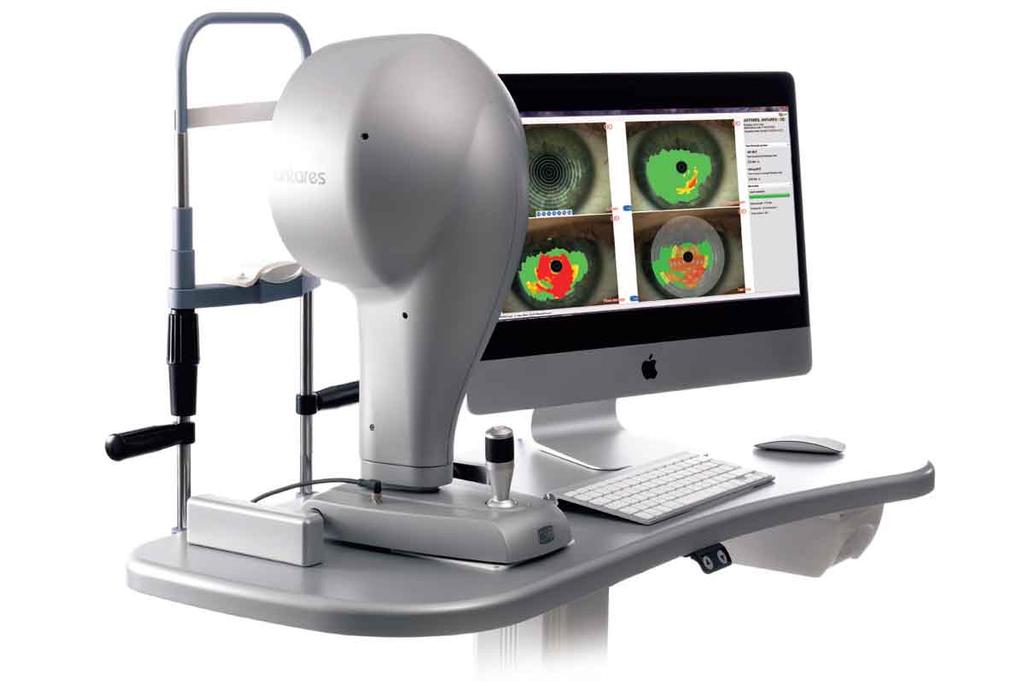
It also has great imaging potential for dry eye patients, enabling infra-red imaging of the vital meibomian glands and tear film analysis.
For more information please read State of the Art Eye Mapping and Tear Film Analysis.
The following images show with a new advanced fluorescein filter attached to a bio-microscope giving unique images of, in this case, a corneal scratch or other corneal injury. Images courtesy of Aston Vision Sciences.
 Image of eye with a new advanced fluorescein filter Image of eye with a new advanced fluorescein filter |
 How it attaches to a bio-microscope How it attaches to a bio-microscope |
|
Microblepharoexfoliation is a painless procedure performed by an eye care professional using a medical device. The instrument has a tiny rotating disposable medical grade micro-sponge to physically scrub the edge of the eyelids and eyelashes, removing the biofilm and exfoliating the eyelids. It works ideally in combination with PBM treatments. Regular microblepharoexfoliation helps to reduce or eradicate the symptoms caused by blepharitis. It can be performed every 4 to 6 months or as needed. This new optional in-practice lid cleaning technique available is designed to supplement home therapies, in order to treat blepharitis more effectively, analogous to dental hygienist cleaning. |
 Microblepharoexfoliation Microblepharoexfoliation |
|
Testing is key as we have learnt, in medical conditions, testing is key, therefore it was decided to obtain a unique assessment tool, available for use in dry eye, contact lens discomfort and pre/post eye surgery patients, this is the ‘InflammaDry’ test, currently the only way of measuring a specific inflammatory marker in clinic to detect and grade the presence of inflammation on the eye’s surface, with results available during the appointment. It is inflammation that is largely responsible for symptoms in the specific groups of patients mentioned. Dry eye or anti-bacterial drops are largely ineffective in these conditions – specific targeted management is needed. This ‘only one in the world’ test is used in my clinic, one of a handful of locations in Great Britain and Eire. |
 Results from a range of results demonstrating degrees of inflammation, otherwise unknown are shown Results from a range of results demonstrating degrees of inflammation, otherwise unknown are shown |